FC Barcelona
B2Engels40 kaarten
Voor meer content, talen en functies download je de mobiele app in de App Store of via Google Play.
On October 22, 1899, Hans Gamper published an ad in a newspaper looking for players to found FC Barcelona.
Op 22 oktober 1899 plaatste Hans Gamper een advertentie in een krant op zoek naar spelers om FC Barcelona op te richten.
FC Barcelona was founded on November 29, 1899, by a group of Swiss, English, and Catalan footballers.
FC Barcelona werd op 29 november 1899 opgericht door een groep Zwitserse, Engelse en Catalaanse voetballers.
Joan Gamper, the founder of the club, was also one of its first players.
Joan Gamper, de oprichter van de club, was ook een van zijn eerste spelers.
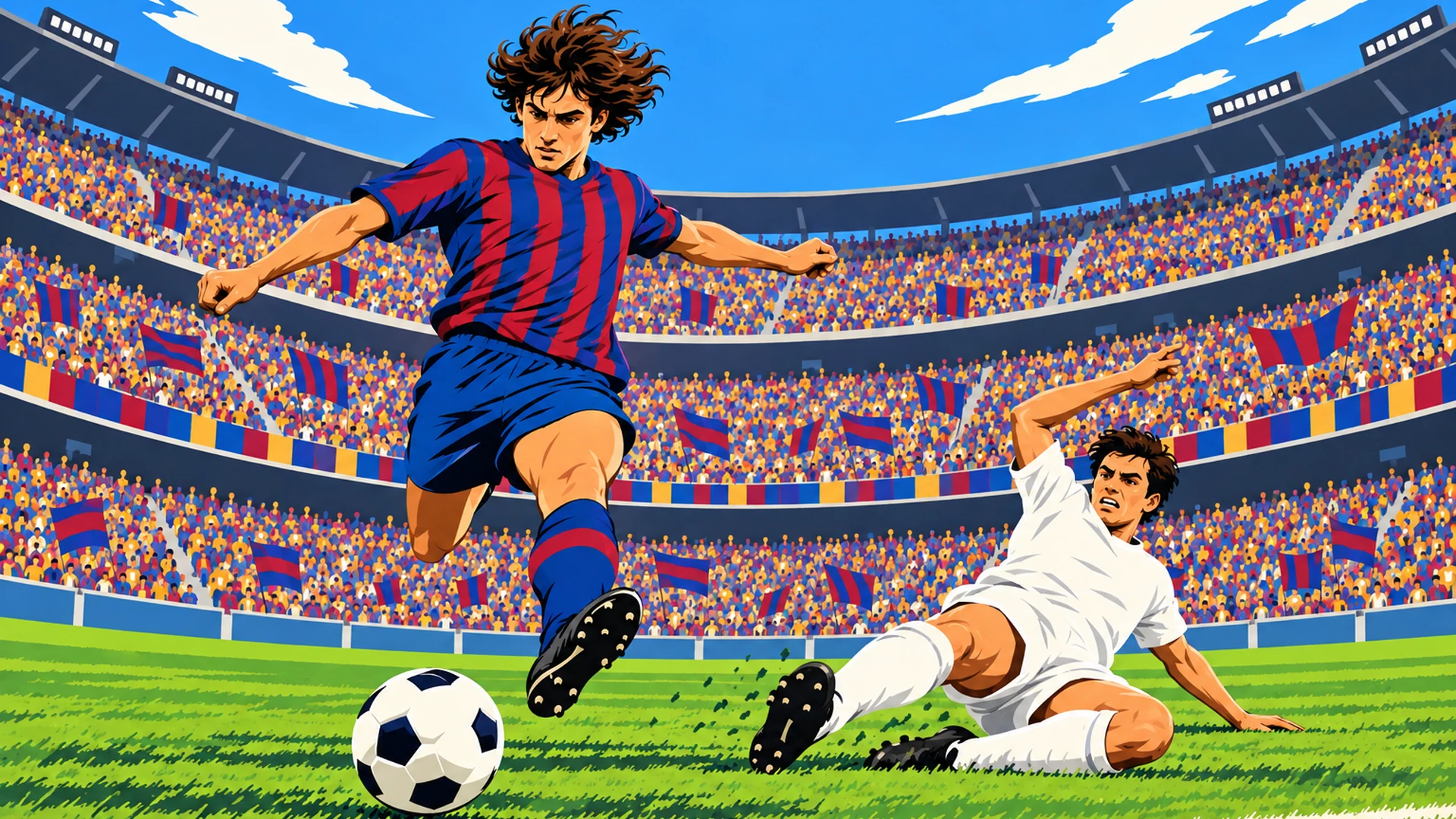
The team's blue and garnet colours have been a symbol since the early days of the club.
De clubkleuren blauw en granaatrood zijn sinds de begindagen van de club een symbool geweest.
The club's motto is 'More than a club,' reflecting its cultural and social importance in Catalonia.
Het motto van de club is 'Meer dan een club', wat de culturele en sociale betekenis ervan in Catalonië weerspiegelt.
Barcelona's crest includes the Catalan flag, a cross, and a football.
Het embleem van Barcelona bevat de Catalaanse vlag, een kruis en een voetbal.
On May 20, 1922, FC Barcelona inaugurated its first own stadium, the Camp de Les Corts.
Op 20 mei 1922 opende FC Barcelona zijn eerste eigen stadion, het Camp de Les Corts.
In 1936, during the Spanish Civil War, FC Barcelona's president, Josep Sunyol, was executed by Francoist forces.
In 1936, tijdens de Spaanse Burgeroorlog, werd de voorzitter van FC Barcelona, Josep Sunyol, geëxecuteerd door de Franco-troepen.
During Franco's dictatorship, FC Barcelona became a symbol of Catalan identity and cultural resistance.
Tijdens de dictatuur van Franco werd FC Barcelona een symbool van de Catalaanse identiteit en culturele weerstand.
The Camp Nou stadium was inaugurated in 1957 and is one of the largest stadiums in Europe.
Het Camp Nou-stadion werd in 1957 geopend en is een van de grootste stadions van Europa.
Camp Nou has been the site of political events, such as demonstrations in support of Catalan independence.
Camp Nou is het toneel geweest van politieke evenementen, zoals demonstraties ter ondersteuning van de Catalaanse onafhankelijkheid.
FC Barcelona supporters are known as 'Culés,' a nickname with more than a century of history.
De supporters van FC Barcelona staan bekend als 'Culés', een bijnaam met meer dan een eeuw geschiedenis.
The origin of the term 'Culé' dates back to the early 20th century, when Barça played at the Industria Street stadium.
De oorsprong van de term 'Culé' gaat terug tot het begin van de 20e eeuw, toen Barça in het stadion aan de Carrer de la Indústria speelde.
From outside the stadium, passersby could see the buttocks of the fans sitting at the top of the stands.
Van buiten het stadion konden voorbijgangers de billen van de fans zien die bovenaan de tribunes zaten.
The word 'Culé' comes from the Catalan word 'cul,' which means 'backside' or 'buttocks'.
Het woord 'Culé' komt van het Catalaanse woord 'cul', wat 'achterwerk' of 'billen' betekent.
Although it was originally an informal nickname, the term 'Culé' became a symbol of identity for Barcelona supporters.
Hoewel het oorspronkelijk een informele bijnaam was, werd de term 'Culé' een symbool van identiteit voor de supporters van Barcelona.
Today, both the players and fans of FC Barcelona are known worldwide as 'Culés'.
Tegenwoordig staan zowel de spelers als de fans van FC Barcelona wereldwijd bekend als 'Culés'.
Josep Samitier, known as 'The Magician,' was one of FC Barcelona's first stars in the 1920s.
Josep Samitier, bekend als 'De Tovenaar', was een van de eerste sterren van FC Barcelona in de jaren 20.
Ramón Torralba, known as 'The Golden Boy,' was a defensive midfielder who played over 500 matches with FC Barcelona.
Ramón Torralba, bekend als 'De Gouden Jongen', was een verdedigende middenvelder die meer dan 500 wedstrijden speelde voor FC Barcelona.
László Kubala is considered a FC Barcelona legend, known for his skill and goals in the 1950s.
László Kubala wordt beschouwd als een legende van FC Barcelona, bekend om zijn vaardigheid en doelpunten in de jaren 50.
Luis Suárez Miramontes won the Ballon d'Or in 1960 as a member of FC Barcelona, the only Spanish player to win this award.
Luis Suárez Miramontes won de Ballon d'Or in 1960 als speler van FC Barcelona, de enige Spaanse voetballer die deze prijs heeft gewonnen.
Johan Cruyff arrived at FC Barcelona in 1973 and revolutionized the team with his talent and leadership, helping them win La Liga in his first season.
Johan Cruijff kwam in 1973 bij FC Barcelona en revolutioneerde het team met zijn talent en leiderschap, waardoor ze in zijn eerste seizoen La Liga wonnen.
As FC Barcelona's coach, Johan Cruyff built the 'Dream Team,' which won the European Cup in 1992, the club's first title in this competition.
Als coach van FC Barcelona bouwde Johan Cruijff het 'Dream Team', dat in 1992 de Europacup won, de eerste titel van de club in deze competitie.
Ronald Koeman scored the decisive goal in the 1992 European Cup final.
Ronald Koeman scoorde het beslissende doelpunt in de finale van de Europacup van 1992.
Hristo Stoichkov, a Bulgarian forward, won the Ballon d'Or in 1994 while playing for FC Barcelona.
Hristo Stoichkov, een Bulgaarse aanvaller, won de Ballon d'Or in 1994 terwijl hij voor FC Barcelona speelde.
Lionel Messi is FC Barcelona's all-time top scorer with 672 goals in official matches.
Lionel Messi is de topscorer aller tijden van FC Barcelona met 672 doelpunten in officiële wedstrijden.
Messi has won 35 trophies with FC Barcelona, making him the most decorated player in the club’s history.
Messi heeft 35 titels gewonnen met FC Barcelona, waarmee hij de meest onderscheiden speler in de geschiedenis van de club is.
On May 27, 2009, Barça became the first Spanish team to win the treble: La Liga, Copa del Rey, and Champions League.
Op 27 mei 2009 werd Barça het eerste Spaanse team dat de treble won: La Liga, Copa del Rey en Champions League.
La Masia is FC Barcelona’s youth academy for training young footballers.
La Masia is de jeugdacademie van FC Barcelona voor het opleiden van jonge voetballers.
The name 'La Masia' comes from an old country house located near Camp Nou.
De naam 'La Masia' komt van een oude boerderij gelegen nabij Camp Nou.
La Masia’s philosophy is based on possession football, ball control, and teamwork.
De filosofie van La Masia is gebaseerd op balbezit, balcontrole en teamwork.
In 2011, La Masia moved to a new facility called Ciutat Esportiva Joan Gamper.
In 2011 verhuisde La Masia naar een nieuwe faciliteit genaamd Ciutat Esportiva Joan Gamper.
For more than 100 years, FC Barcelona refused to have a commercial sponsor on their jersey, something unique among major football clubs.
Meer dan 100 jaar lang weigerde FC Barcelona een commerciële sponsor op zijn shirt te hebben, iets unieks onder de grote voetbalclubs.
In 2006, FC Barcelona broke its tradition by agreeing to display the UNICEF logo on its jersey, but without receiving money in return.
In 2006 brak FC Barcelona met zijn traditie door ermee in te stemmen het UNICEF-logo op zijn shirt te dragen, maar zonder daar geld voor te ontvangen.
In 2011, the club signed its first paid sponsorship deal with Qatar Foundation, which caused controversy among fans.
In 2011 tekende de club zijn eerste betaalde sponsorcontract met Qatar Foundation, wat controverse veroorzaakte onder de fans.
Many fans saw the absence of advertising on the jersey as a symbol of FC Barcelona's identity and values.
Veel fans zagen de afwezigheid van reclame op het shirt als een symbool van de identiteit en waarden van FC Barcelona.
Unlike many European football clubs, FC Barcelona is not owned by a single businessman or company.
In tegenstelling tot veel Europese voetbalclubs is FC Barcelona niet eigendom van een enkele zakenman of bedrijf.
The club is owned by its members, who have the right to vote in presidential elections.
De club is eigendom van zijn leden, die het recht hebben om bij de voorzittersverkiezingen te stemmen.
FC Barcelona is one of the few sports entities managed as a non-profit club.
FC Barcelona is een van de weinige sportorganisaties die als een club zonder winstoogmerk worden bestuurd.
Unlike clubs with private owners, FC Barcelona cannot be sold or bought by external investors.
In tegenstelling tot clubs met particuliere eigenaren kan FC Barcelona niet worden verkocht of gekocht door externe investeerders.