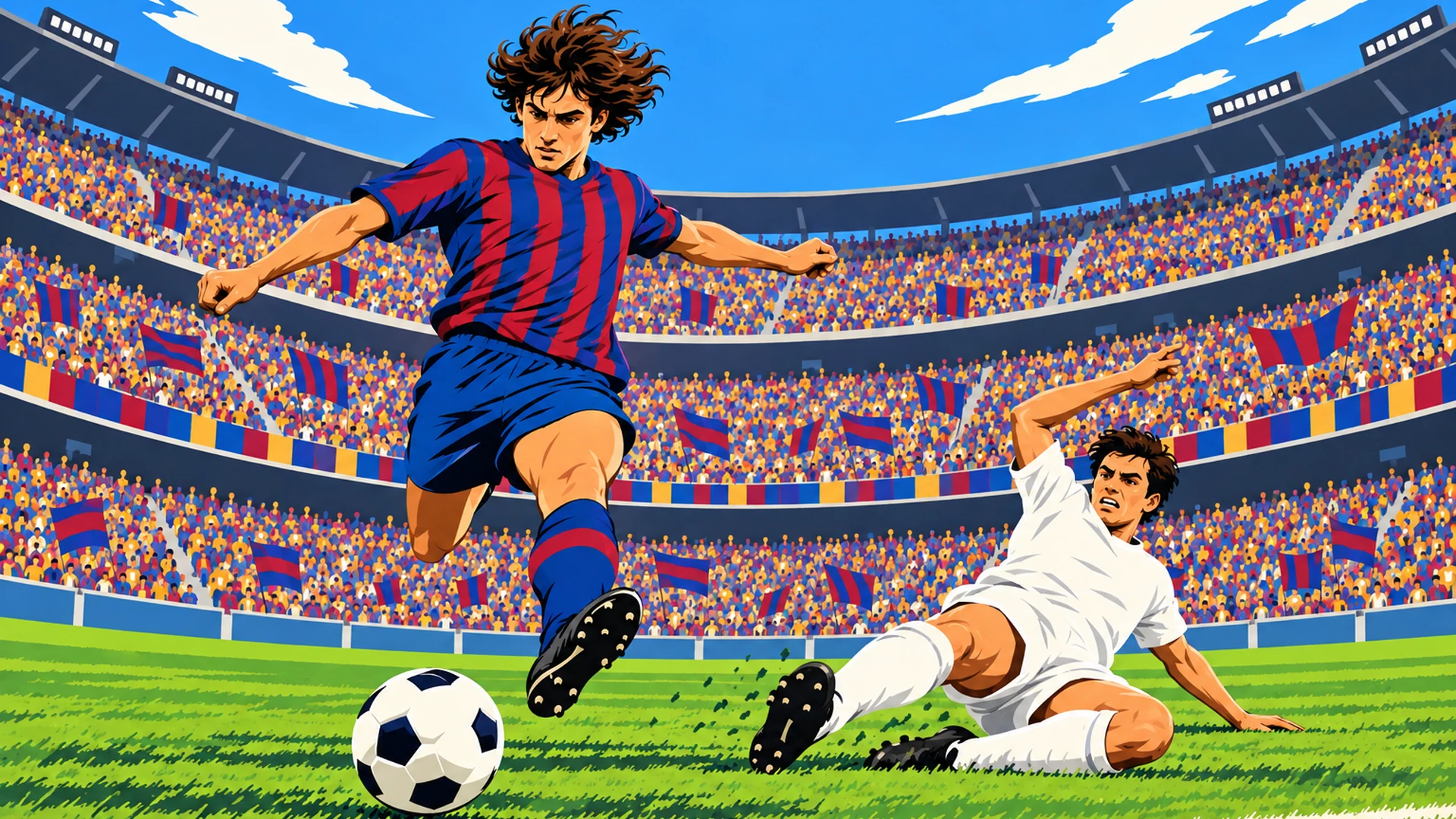
FC Barcelona
B2Engelsk40 kort
Vil du ha mer innhold, flere språk og flere funksjoner? Last ned mobilappen fra App Store eller Google Play.
On October 22, 1899, Hans Gamper published an ad in a newspaper looking for players to found FC Barcelona.
Den 22. oktober 1899 publiserte Hans Gamper en annonse i en avis for å finne spillere til å grunnlegge FC Barcelona.
FC Barcelona was founded on November 29, 1899, by a group of Swiss, English, and Catalan footballers.
FC Barcelona ble grunnlagt 29. november 1899 av en gruppe sveitsiske, engelske og katalanske fotballspillere.
Joan Gamper, the founder of the club, was also one of its first players.
Joan Gamper, klubbens grunnlegger, var også en av de første spillerne.
The team's blue and garnet colours have been a symbol since the early days of the club.
Lagets blå og granatrøde farger har vært et symbol siden klubbens første dager.
The club's motto is 'More than a club,' reflecting its cultural and social importance in Catalonia.
Klubbens motto er «Mer enn en klubb», noe som gjenspeiler klubbens kulturelle og sosiale betydning i Catalonia.
Barcelona's crest includes the Catalan flag, a cross, and a football.
Barcelonas emblem inneholder Catalonias flagg, et kors og en fotball.
On May 20, 1922, FC Barcelona inaugurated its first own stadium, the Camp de Les Corts.
20. mai 1922 åpnet FC Barcelona sitt første eget stadion, Camp de Les Corts.
In 1936, during the Spanish Civil War, FC Barcelona's president, Josep Sunyol, was executed by Francoist forces.
I 1936, under den spanske borgerkrigen, ble FC Barcelonas president, Josep Sunyol, henrettet av frankistiske styrker.
During Franco's dictatorship, FC Barcelona became a symbol of Catalan identity and cultural resistance.
Under Francos diktatur ble FC Barcelona et symbol på katalansk identitet og kulturell motstand.
The Camp Nou stadium was inaugurated in 1957 and is one of the largest stadiums in Europe.
Camp Nou stadion åpnet i 1957 og er et av de største stadionene i Europa.
Camp Nou has been the site of political events, such as demonstrations in support of Catalan independence.
Camp Nou har vært åsted for politiske begivenheter, som demonstrasjoner til støtte for katalansk uavhengighet.
FC Barcelona supporters are known as 'Culés,' a nickname with more than a century of history.
FC Barcelonas tilhengere er kjent som «Culés», et kallenavn med over hundre års historie.
The origin of the term 'Culé' dates back to the early 20th century, when Barça played at the Industria Street stadium.
Opprinnelsen til begrepet «Culé» går tilbake til begynnelsen av 1900-tallet, da Barça spilte på stadionet i Industria-gaten.
From outside the stadium, passersby could see the buttocks of the fans sitting at the top of the stands.
Fra utsiden av stadionet kunne forbipasserende se rumpene til supporterne som satt øverst på tribunene.
The word 'Culé' comes from the Catalan word 'cul,' which means 'backside' or 'buttocks'.
Ordet «Culé» kommer fra det katalanske ordet «cul», som betyr «bakdel» eller «rumpe».
Although it was originally an informal nickname, the term 'Culé' became a symbol of identity for Barcelona supporters.
Selv om det opprinnelig var et uformelt kallenavn, ble begrepet «Culé» et identitetssymbol for Barcelonas tilhengere.
Today, both the players and fans of FC Barcelona are known worldwide as 'Culés'.
I dag er både FC Barcelonas spillere og supportere kjent over hele verden som «Culés».
Josep Samitier, known as 'The Magician,' was one of FC Barcelona's first stars in the 1920s.
Josep Samitier, kjent som «Tryllekunstneren», var en av FC Barcelonas første stjerner på 1920-tallet.
Ramón Torralba, known as 'The Golden Boy,' was a defensive midfielder who played over 500 matches with FC Barcelona.
Ramón Torralba, kjent som «Gullgutten», var en defensiv midtbanespiller som spilte over 500 kamper for FC Barcelona.
László Kubala is considered a FC Barcelona legend, known for his skill and goals in the 1950s.
László Kubala regnes som en legende i FC Barcelona, kjent for ferdighetene sine og målene sine på 1950-tallet.
Luis Suárez Miramontes won the Ballon d'Or in 1960 as a member of FC Barcelona, the only Spanish player to win this award.
Luis Suárez Miramontes vant Ballon d'Or i 1960 som FC Barcelona-spiller, og er den eneste spanske fotballspilleren som har vunnet denne prisen.
Johan Cruyff arrived at FC Barcelona in 1973 and revolutionized the team with his talent and leadership, helping them win La Liga in his first season.
Johan Cruyff kom til FC Barcelona i 1973 og revolusjonerte laget med talentet og lederegenskapene sine, og bidro til at laget vant La Liga i hans første sesong.
As FC Barcelona's coach, Johan Cruyff built the 'Dream Team,' which won the European Cup in 1992, the club's first title in this competition.
Som trener for FC Barcelona bygde Johan Cruyff «Dream Team», som vant Europacupen i 1992, klubbens første tittel i denne turneringen.
Ronald Koeman scored the decisive goal in the 1992 European Cup final.
Ronald Koeman scoret det avgjørende målet i finalen i Europacupen i 1992.
Hristo Stoichkov, a Bulgarian forward, won the Ballon d'Or in 1994 while playing for FC Barcelona.
Hristo Stoichkov, en bulgarsk spiss, vant Ballon d'Or i 1994 mens han spilte for FC Barcelona.
Lionel Messi is FC Barcelona's all-time top scorer with 672 goals in official matches.
Lionel Messi er FC Barcelonas toppscorer gjennom tidene med 672 mål i offisielle kamper.
Messi has won 35 trophies with FC Barcelona, making him the most decorated player in the club’s history.
Messi har vunnet 35 titler med FC Barcelona, noe som gjør ham til klubbens mest meritterte spiller gjennom tidene.
On May 27, 2009, Barça became the first Spanish team to win the treble: La Liga, Copa del Rey, and Champions League.
27. mai 2009 ble Barça det første spanske laget som vant treblet: La Liga, Copa del Rey og Champions League.
La Masia is FC Barcelona’s youth academy for training young footballers.
La Masia er FC Barcelonas akademi for unge fotballspillere.
The name 'La Masia' comes from an old country house located near Camp Nou.
Navnet «La Masia» kommer fra et gammelt gårdshus som ligger nær Camp Nou.
La Masia’s philosophy is based on possession football, ball control, and teamwork.
La Masias filosofi bygger på ballbesittende spill, ballkontroll og lagarbeid.
In 2011, La Masia moved to a new facility called Ciutat Esportiva Joan Gamper.
I 2011 flyttet La Masia til et nytt anlegg kalt Ciutat Esportiva Joan Gamper.
For more than 100 years, FC Barcelona refused to have a commercial sponsor on their jersey, something unique among major football clubs.
I over 100 år nektet FC Barcelona å ha en kommersiell sponsor på drakten, noe som er unikt blant store fotballklubber.
In 2006, FC Barcelona broke its tradition by agreeing to display the UNICEF logo on its jersey, but without receiving money in return.
I 2006 brøt FC Barcelona med tradisjonen sin ved å godta å ha UNICEF-logoen på drakten, men uten å motta penger for det.
In 2011, the club signed its first paid sponsorship deal with Qatar Foundation, which caused controversy among fans.
I 2011 inngikk klubben sin første betalte sponsoravtale med Qatar Foundation, noe som skapte kontrovers blant supporterne.
Many fans saw the absence of advertising on the jersey as a symbol of FC Barcelona's identity and values.
Mange supportere så fraværet av reklame på drakten som et symbol på FC Barcelonas identitet og verdier.
Unlike many European football clubs, FC Barcelona is not owned by a single businessman or company.
I motsetning til mange europeiske fotballklubber eies ikke FC Barcelona av én enkelt forretningsmann eller bedrift.
The club is owned by its members, who have the right to vote in presidential elections.
Klubben eies av medlemmene sine, som har stemmerett ved presidentvalgene.
FC Barcelona is one of the few sports entities managed as a non-profit club.
FC Barcelona er en av få idrettsorganisasjoner som drives som en ideell klubb.
Unlike clubs with private owners, FC Barcelona cannot be sold or bought by external investors.
I motsetning til klubber med private eiere kan FC Barcelona ikke selges eller kjøpes av eksterne investorer.