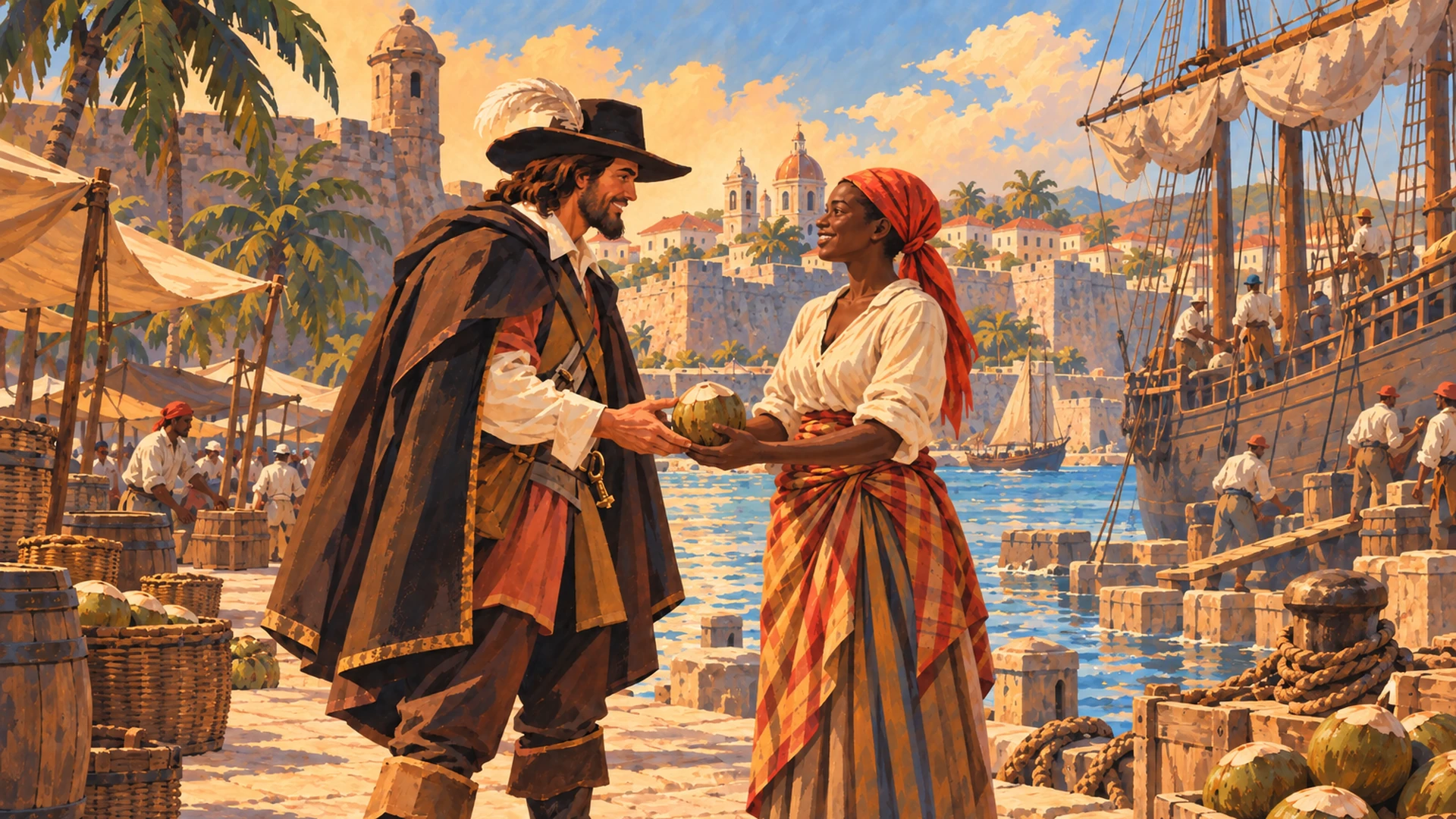
Cartagena de Indias 1683
B2Angol26 kártya
Még több tartalomért, nyelvért és funkcióért töltsd le a mobilalkalmazást az App Store vagy a Google Play áruházból.
I was in the port of Cartagena de Indias, and the year was 1683.
Cartagena de Indias kikötőjében voltam, és az év 1683 volt.
The sun had already risen over the Caribbean Sea.
A nap már felkelt a Karib-tenger felett.
The air smelled of salt, damp wood, and spices. Everything looked old, but full of life.
A levegő só, nedves fa és fűszerek illatát árasztotta. Minden régi volt, de tele élettel.
The merchants were shouting their prices as they unloaded goods from the latest galleon.
A kereskedők kiabálták áraikat, miközben kirakodták az árukat az utolsó gályáról.
I saw some sailors talking about an English ship seen near the coast.
Láttam néhány matrózt, akik egy angol hajóról beszéltek, amelyet a partok közelében láttak.
A young man was selling coconuts on the corner and offered me one for two reales.
Egy fiatalember kókuszdiót árult a sarkon, és felajánlott nekem egyet két realért.
From the top of the city walls, you could see the sea and hear the sounds of the port.
A falak tetejéről látni lehetett a tengert és hallani a kikötő hangjait.
I entered the city through the Boca del Puente, the main entrance to Cartagena.
A Boca del Puente-n keresztül léptem be a városba, amely Cartagena főbejárata.
In the Plaza de los Coches, the vendors were offering tropical fruits under colourful umbrellas.
A Plaza de los Coches téren az árusok trópusi gyümölcsöket kínáltak színes napernyők alatt.
A lady in the plaza told me that the Zapata family would host a grand dance that week.
Egy hölgy a téren azt mondta nekem, hogy a Zapata család nagy táncot szervezett arra a hétre.
I saw some children running barefoot through the plaza.
Láttam néhány gyereket mezítláb futni a téren.
The Street of the Inquisition was narrow and quiet, but everyone avoided talking about the building at the end.
A Calle de la Inquisición szűk és csendes volt, de mindenki kerülte, hogy beszéljen az utca végén lévő épületről.
I walked along Archbishop’s Street, where the houses had wooden balconies full of flowers.
A Calle del Arzobispado-n sétáltam, ahol a házaknak faerkélyeik voltak, tele virágokkal.
Doña Teresa Céspedes passed by in her carriage, covered with a white lace veil.
Doña Teresa Céspedes elhaladt hintójában, fehér csipkefátyollal borítva.
Doctor Fernández de Madrid walked by in his black cape, and many greeted him with respect.
Dr. Fernández de Madrid fekete köpenyben sétált, és sokan tisztelettel köszöntötték.
Father Ignacio, a beloved Jesuit, was speaking with some children in front of the convent.
Ignacio atya, egy szeretett jezsuita, néhány gyerekkel beszélgetett a kolostor előtt.
A boy told me that Don Tomás, the baker, always saved the best bread for the soldiers.
Egy fiú azt mondta nekem, hogy Don Tomás, a pék, mindig a legjobb kenyeret tartotta meg a katonáknak.
I heard that Don Alonso Valdés received news of a shipment of cacao from Venezuela.
Hallottam, hogy Don Alonso Valdés hírt kapott egy kakaószállítmányról Venezuelából.
They said Don Rodrigo Montenegro wanted to buy another house near the city wall.
Azt mondták, hogy Don Rodrigo Montenegro egy másik házat akart venni a városfal közelében.
In the apothecary shop, Señora Gómez said her son saw a French ship from the hill.
A patikában Señora Gómez azt mondta, hogy a fia látott egy francia hajót a dombról.
In the tavern, a sailor said that young Blas de Lezo wanted to set sail for Havana.
A kocsmában egy matróz azt mondta, hogy a fiatal Blas de Lezo el akart hajózni Havanna felé.
I passed through the Customs Square, where officials walked with papers in hand and serious faces.
Áthaladtam a Plaza de la Aduana téren, ahol a tisztviselők papírokkal a kezükben és komoly arccal sétáltak.
In San Pedro Claver Square, a group of newly arrived enslaved people waited silently under the sun.
A San Pedro Claver téren egy csoport frissen érkezett rabszolga várt csendben a nap alatt.
I saw the Castle of San Felipe in the distance, towering over the city from a hill.
Láttam a San Felipe kastélyt a távolban, ahogy egy domb tetejéről uralta a várost.
At sunset, people walked along the city walls to watch the sun sink into the Caribbean Sea.
Naplementekor az emberek a városfalakon sétáltak, hogy megnézzék, ahogy a nap a Karib-tengerbe süllyed.
Cartagena was full of life, colours, and rumours — a city that never completely slept.
Cartagena tele volt élettel, színekkel és pletykákkal — egy város, amely soha nem aludt teljesen.