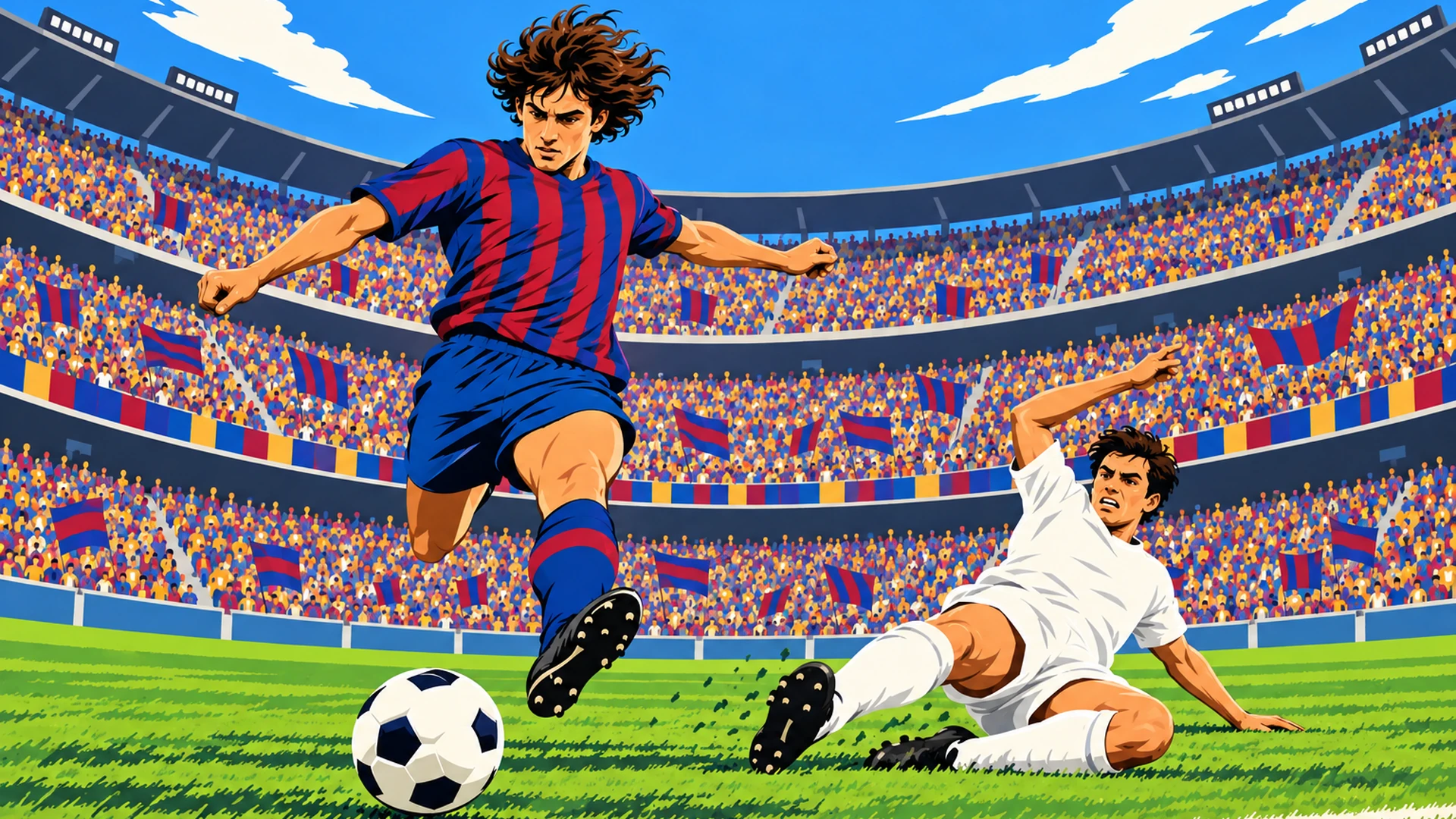
FC Barcelona
B2Deutsch40 Karten
Mehr Inhalte, Sprachen und Funktionen bekommst du in der mobilen App – im App Store oder bei Google Play.
Am 22. Oktober 1899 veröffentlichte Hans Gamper eine Anzeige in einer Zeitung, in der er Spieler suchte, um den FC Barcelona zu gründen.
On October 22, 1899, Hans Gamper published an ad in a newspaper looking for players to found FC Barcelona.
Der FC Barcelona wurde am 29. November 1899 von einer Gruppe schweizerischer, englischer und katalanischer Fußballspieler gegründet.
FC Barcelona was founded on November 29, 1899, by a group of Swiss, English, and Catalan footballers.
Joan Gamper, der Gründer des Clubs, war auch einer seiner ersten Spieler.
Joan Gamper, the founder of the club, was also one of its first players.
Die blauen und granatroten Farben des Teams sind seit den frühen Tagen des Clubs ein Symbol.
The team's blue and garnet colours have been a symbol since the early days of the club.
Das Motto des Clubs ist 'Mehr als ein Club', was seine kulturelle und soziale Bedeutung in Katalonien widerspiegelt.
The club's motto is 'More than a club,' reflecting its cultural and social importance in Catalonia.
Das Wappen von Barcelona enthält die katalanische Flagge, ein Kreuz und einen Fußball.
Barcelona's crest includes the Catalan flag, a cross, and a football.
Am 20. Mai 1922 eröffnete der FC Barcelona sein erstes eigenes Stadion, das Camp de Les Corts.
On May 20, 1922, FC Barcelona inaugurated its first own stadium, the Camp de Les Corts.
1936, während des Spanischen Bürgerkriegs, wurde der Präsident des FC Barcelona, Josep Sunyol, von den franquistischen Kräften ermordet.
In 1936, during the Spanish Civil War, FC Barcelona's president, Josep Sunyol, was executed by Francoist forces.
Während der Diktatur Francos wurde der FC Barcelona zu einem Symbol der katalanischen Identität und des kulturellen Widerstands.
During Franco's dictatorship, FC Barcelona became a symbol of Catalan identity and cultural resistance.
Das Camp Nou Stadion wurde 1957 eingeweiht und ist eines der größten Stadien in Europa.
The Camp Nou stadium was inaugurated in 1957 and is one of the largest stadiums in Europe.
Das Camp Nou war Schauplatz politischer Veranstaltungen, wie Demonstrationen zur Unterstützung der katalanischen Unabhängigkeit.
Camp Nou has been the site of political events, such as demonstrations in support of Catalan independence.
Die Anhänger des FC Barcelona sind als 'Culés' bekannt, ein Spitzname mit mehr als einem Jahrhundert Geschichte.
FC Barcelona supporters are known as 'Culés,' a nickname with more than a century of history.
Der Ursprung des Begriffs 'Culé' geht auf das frühe 20. Jahrhundert zurück, als Barça im Stadion der Industria-Straße spielte.
The origin of the term 'Culé' dates back to the early 20th century, when Barça played at the Industria Street stadium.
Von außerhalb des Stadions konnten Passanten die Gesäße der Fans sehen, die oben auf den Tribünen saßen.
From outside the stadium, passersby could see the buttocks of the fans sitting at the top of the stands.
Das Wort 'Culé' stammt vom katalanischen Wort 'cul', das 'Hinterteil' oder 'Gesäß' bedeutet.
The word 'Culé' comes from the Catalan word 'cul,' which means 'backside' or 'buttocks'.
Obwohl es ursprünglich ein informeller Spitzname war, wurde der Begriff 'Culé' zu einem Identitätssymbol für die Anhänger von Barcelona.
Although it was originally an informal nickname, the term 'Culé' became a symbol of identity for Barcelona supporters.
Heutzutage sind sowohl die Spieler als auch die Fans des FC Barcelona weltweit als 'Culés' bekannt.
Today, both the players and fans of FC Barcelona are known worldwide as 'Culés'.
Josep Samitier, bekannt als 'Der Magier', war in den 1920er Jahren einer der ersten Stars des FC Barcelona.
Josep Samitier, known as 'The Magician,' was one of FC Barcelona's first stars in the 1920s.
Ramón Torralba, bekannt als 'Der Goldjunge', war ein defensiver Mittelfeldspieler, der über 500 Spiele für den FC Barcelona bestritt.
Ramón Torralba, known as 'The Golden Boy,' was a defensive midfielder who played over 500 matches with FC Barcelona.
László Kubala wird als Legende des FC Barcelona angesehen, bekannt für seine Fähigkeiten und Tore in den 1950er Jahren.
László Kubala is considered a FC Barcelona legend, known for his skill and goals in the 1950s.
Luis Suárez Miramontes gewann 1960 den Ballon d'Or als Spieler des FC Barcelona und ist der einzige spanische Fußballer, der diese Auszeichnung erhalten hat.
Luis Suárez Miramontes won the Ballon d'Or in 1960 as a member of FC Barcelona, the only Spanish player to win this award.
Johan Cruyff kam 1973 zum FC Barcelona und revolutionierte das Team mit seinem Talent und Führungsqualitäten, indem er ihnen half, in seiner ersten Saison die La Liga zu gewinnen.
Johan Cruyff arrived at FC Barcelona in 1973 and revolutionized the team with his talent and leadership, helping them win La Liga in his first season.
Als Trainer des FC Barcelona baute Johan Cruyff das 'Dream Team' auf, das 1992 den Europapokal gewann, den ersten Titel des Vereins in diesem Wettbewerb.
As FC Barcelona's coach, Johan Cruyff built the 'Dream Team,' which won the European Cup in 1992, the club's first title in this competition.
Ronald Koeman erzielte das entscheidende Tor im Europapokal-Finale 1992.
Ronald Koeman scored the decisive goal in the 1992 European Cup final.
Hristo Stoichkov, ein bulgarischer Stürmer, gewann den Ballon d'Or im Jahr 1994, während er für den FC Barcelona spielte.
Hristo Stoichkov, a Bulgarian forward, won the Ballon d'Or in 1994 while playing for FC Barcelona.
Lionel Messi ist der Rekordtorschütze des FC Barcelona mit 672 Toren in offiziellen Spielen.
Lionel Messi is FC Barcelona's all-time top scorer with 672 goals in official matches.
Messi hat 35 Titel mit dem FC Barcelona gewonnen und ist damit der am meisten ausgezeichnete Spieler in der Geschichte des Vereins.
Messi has won 35 trophies with FC Barcelona, making him the most decorated player in the club’s history.
Am 27. Mai 2009 wurde Barça das erste spanische Team, das das Triple gewann: La Liga, Copa del Rey und Champions League.
On May 27, 2009, Barça became the first Spanish team to win the treble: La Liga, Copa del Rey, and Champions League.
La Masia ist die Jugendakademie des FC Barcelona zur Ausbildung junger Fußballspieler.
La Masia is FC Barcelona’s youth academy for training young footballers.
Der Name 'La Masia' stammt von einem alten Landhaus in der Nähe des Camp Nou.
The name 'La Masia' comes from an old country house located near Camp Nou.
Die Philosophie von La Masia basiert auf Ballbesitzfußball, Ballkontrolle und Teamarbeit.
La Masia’s philosophy is based on possession football, ball control, and teamwork.
Im Jahr 2011 zog La Masia in eine neue Einrichtung namens Ciutat Esportiva Joan Gamper um.
In 2011, La Masia moved to a new facility called Ciutat Esportiva Joan Gamper.
Mehr als 100 Jahre lang weigerte sich der FC Barcelona, einen kommerziellen Sponsor auf seinem Trikot zu haben, etwas Einzigartiges unter den großen Fußballvereinen.
For more than 100 years, FC Barcelona refused to have a commercial sponsor on their jersey, something unique among major football clubs.
Im Jahr 2006 brach der FC Barcelona mit seiner Tradition, indem er zustimmte, das UNICEF-Logo auf seinem Trikot zu tragen, jedoch ohne dafür Geld zu erhalten.
In 2006, FC Barcelona broke its tradition by agreeing to display the UNICEF logo on its jersey, but without receiving money in return.
Im Jahr 2011 unterzeichnete der Verein seinen ersten bezahlten Sponsorenvertrag mit der Qatar Foundation, was unter den Fans für Kontroversen sorgte.
In 2011, the club signed its first paid sponsorship deal with Qatar Foundation, which caused controversy among fans.
Viele Fans sahen das Fehlen von Werbung auf dem Trikot als ein Symbol für die Identität und Werte des FC Barcelona.
Many fans saw the absence of advertising on the jersey as a symbol of FC Barcelona's identity and values.
Im Gegensatz zu vielen europäischen Fußballvereinen gehört der FC Barcelona nicht einem einzelnen Unternehmer oder Unternehmen.
Unlike many European football clubs, FC Barcelona is not owned by a single businessman or company.
Der Verein gehört seinen Mitgliedern, die das Recht haben, bei Präsidentschaftswahlen zu wählen.
The club is owned by its members, who have the right to vote in presidential elections.
Der FC Barcelona ist eine der wenigen Sporteinrichtungen, die als gemeinnütziger Verein geführt werden.
FC Barcelona is one of the few sports entities managed as a non-profit club.
Im Gegensatz zu Vereinen mit privaten Eigentümern kann der FC Barcelona nicht von externen Investoren verkauft oder gekauft werden.
Unlike clubs with private owners, FC Barcelona cannot be sold or bought by external investors.